
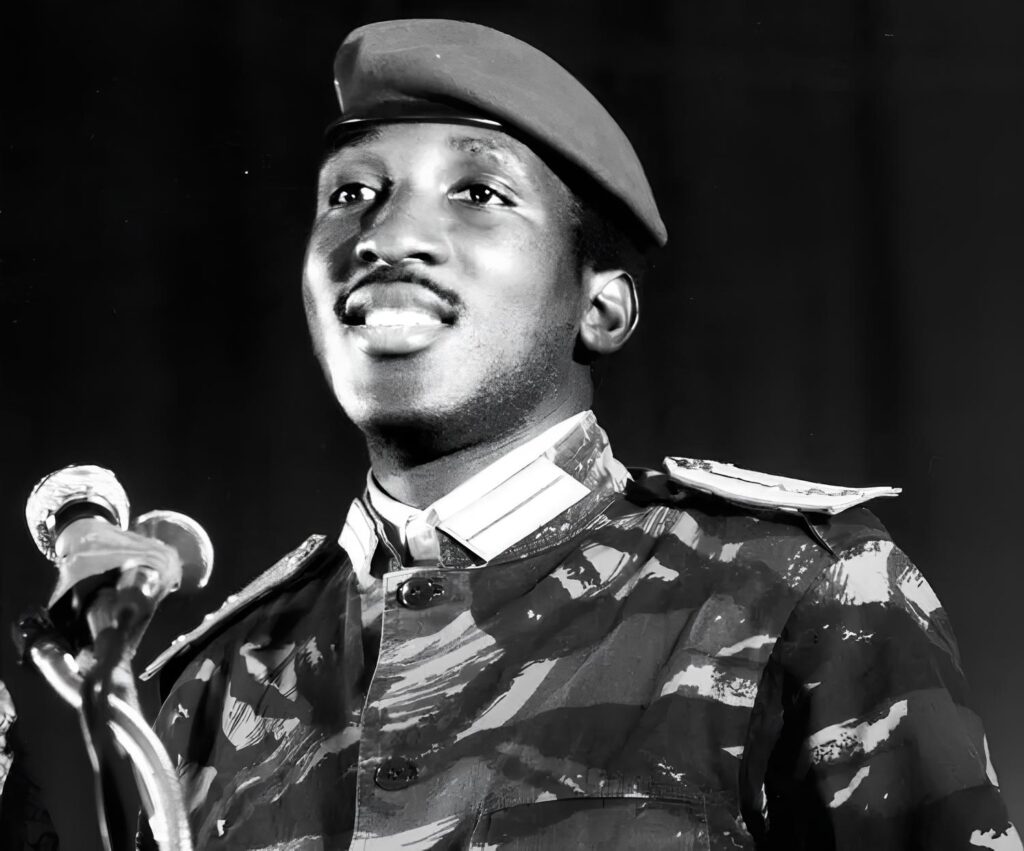
Thomas Sankara: The Revolutionary Leader of Burkina Faso
Thomas Isidore Noël Sankara (21 December 1949 – 15 October 1987) was a Burkinabè military officer, Marxist revolutionary, and Pan-Africanist who served as Burkina Faso’s President from 1983 until his assassination in 1987. His rise to power began with a coup in 1983, following his appointment as Prime Minister and subsequent imprisonment due to disagreements with the government. While under house arrest, a revolutionary group staged a coup on his behalf, with widespread popular support.
At just 33, Sankara became President of Upper Volta, initiating transformative social, ecological, and economic reforms. In 1984, he renamed the country Burkina Faso, meaning “Land of Incorruptible People,” and personally wrote its national anthem. The people became known as Burkinabé, or “upright people.” His anti-imperialist policies rejected loans from institutions like the IMF, although he accepted selective foreign aid to boost self-sufficiency and economic growth.
Domestically, Sankara’s policies tackled famine prevention, agrarian reform, land redistribution, and the abolition of rural poll taxes. He launched nationwide vaccination drives, significantly reducing diseases like meningitis and measles, and implemented literacy campaigns. His administration built schools, health centers, reservoirs, and infrastructure while combating desertification by planting over 10 million trees. Socially, he banned female circumcision, forced marriages, and polygamy. To project a populist image, Sankara reduced government spending, prohibiting luxury items and air conditioning for officials. Inspired by Cuba, he formed Committees for the Defence of the Revolution to mobilize the public. His Popular Revolutionary Tribunals prosecuted officials for corruption, though Amnesty International criticized alleged human rights abuses.
Sankara’s vision of African self-reliance inspired many, making him a symbol of hope across the continent. Despite his popularity among the masses, some policies alienated tribal leaders, former elites, and foreign governments like France and Ivory Coast.
On 15 October 1987, Sankara was assassinated in a coup led by Blaise Compaoré, who ruled until the 2014 Burkina Faso uprising. In 2021, Compaoré was found guilty of Sankara’s murder by a military tribunal.
Early Life and Education
Thomas Sankara was born on 21 December 1949 in Yako, French Upper Volta, as the third of ten children to Joseph and Marguerite Sankara. His father, a gendarme, had mixed Mossi-Fulani heritage, while his mother was of Mossi descent. The family lived in Gaoua, where Sankara enjoyed a relatively privileged childhood due to his father’s colonial employment. He excelled in school, particularly in mathematics and French, and considered priesthood before opting for secular education at the lycée in Bobo-Dioulasso, where he formed lasting friendships.
Drawn to the military’s reputation for discipline and modernization, Sankara joined the Kadiogo Military Academy in 1966. There, he witnessed the country’s first military coup and engaged in political discussions about imperialism, socialism, and liberation movements. He also pursued his passion for music, playing the guitar.
In 1970, Sankara furthered his studies at Madagascar’s Antsirabe Military Academy, where he learned agricultural techniques and strategies to improve farmers’ livelihoods. He read extensively on history and military strategy, shaping his revolutionary ideology and approach to governance.
Thomas Sankara: Military Career and Rise to Leadership
Military Career
Thomas Sankara began his military career at 19 after completing basic training in secondary school in 1966. In 1967, he went to Madagascar for officer training in Antsirabe, where he witnessed the 1971–1972 popular uprisings against President Philibert Tsiranana. During this time, he read the works of Karl Marx and Vladimir Lenin, which deeply shaped his political philosophy.
Returning to Upper Volta in 1972, Sankara participated in a border conflict with Mali in 1974, earning recognition for his bravery. However, he later condemned the war as “useless and unjust,” reflecting his evolving political consciousness. In Ouagadougou, Sankara became a well-known figure, playing the guitar in a band called Tout-à-Coup Jazz and frequently riding a bicycle, enhancing his populist image.
By 1976, he was commander of the Commando Training Centre in Pô. During Colonel Saye Zerbo’s presidency, Sankara and other young officers, including Henri Zongo, Jean-Baptiste Boukary Lingani, and Blaise Compaoré, formed a clandestine organization called ROC, aiming to promote revolutionary ideals.
Government Roles
In September 1981, Sankara was appointed Minister of Information in Saye Zerbo’s government. He stood out by biking to work and encouraging press freedom, a stark contrast to his predecessors who censored the media. Under his leadership, journalists were empowered to investigate and publish government scandals, leading to unprecedented transparency. However, Sankara resigned on 12 April 1982, criticizing the regime’s anti-labor stance with the declaration, “Misfortune to those who gag the people!”
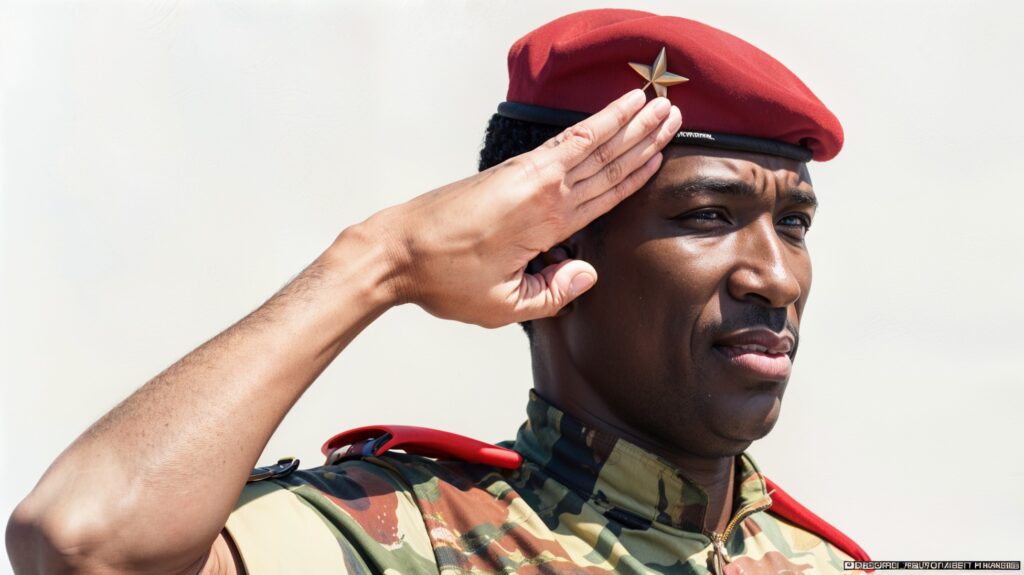
After a coup on 7 November 1982 brought Major-Doctor Jean-Baptiste Ouédraogo to power, Sankara became Prime Minister in January 1983. During his brief tenure, he advocated for progressive reforms, which created tensions within the regime. On 17 May 1983, he was dismissed and arrested after a meeting between French President François Mitterrand’s African affairs adviser and Colonel Yorian Somé. His allies, Henri Zongo and Jean-Baptiste Boukary Lingani, were also detained.
Sankara’s arrest angered younger military officers, creating the momentum for Blaise Compaoré to orchestrate another coup, paving the way for Sankara’s rise to leadership.
Thomas Sankara’s Presidency
Rise to Power
Thomas Sankara became President of Burkina Faso on 4 August 1983, following a coup led by Blaise Compaoré. At 33, Sankara assumed leadership with support from Libya, which was then in conflict with France over Chad. Influenced by revolutionary figures such as Fidel Castro, Che Guevara, and Jerry Rawlings, Sankara embraced anti-imperialist policies under the “Democratic and Popular Revolution” (RDP) framework. In his “Discours d’orientation politique” speech, he outlined his vision of fighting corruption and promoting reforestation.
On the first anniversary of his presidency, Sankara renamed the country Burkina Faso, meaning “Land of Upright People,” introduced a new flag, and composed the national anthem.
Council of the Revolution
Sankara established the Council of the Revolution (CNR), a civilian and military body focused on political and social change. Membership was kept secret for security, with decisions made collectively. On occasion, the CNR overruled Sankara’s proposals, demonstrating its independence and collaborative nature.
Healthcare and Public Works
Sankara prioritized healthcare, housing, and infrastructure. He launched a mass vaccination campaign that immunized 2 million people against polio, meningitis, and measles, reducing infant mortality from 20.8% to 14.5%. His government was the first in Africa to address the AIDS epidemic publicly.
To tackle housing shortages, Sankara established brick factories to build affordable homes, reduce slums, and create jobs. He initiated extensive infrastructure projects, connecting the country with over 700 kilometers of rail built without foreign aid. His environmental efforts included planting millions of trees to combat deforestation and promote sustainable agriculture.
Education
Faced with a 90% illiteracy rate, Sankara’s administration implemented education reforms that significantly improved literacy. Although progress stalled after his death due to teacher strikes and changes in governance, his initial efforts laid a foundation for improvement.
Agriculture
With over 90% of the population reliant on agriculture, Sankara focused heavily on improving the sector. Volunteer-led irrigation projects increased irrigated land by 25%, while fertilizer use rose by 56%. A dam in Sourou Valley and the introduction of tractors boosted agricultural output.
Cereal banks were established to help farmers store and market their crops, reducing dependence on exploitative merchants. In 1984, Sankara nationalized all land, eliminating the control of local chiefs and private ownership. Between 1983 and 1986, cereal production increased by 75%, leading UN analysts to declare Burkina Faso self-sufficient in food production.
Through his revolutionary policies, Sankara sought to empower Burkina Faso and make it a model for self-reliance in Africa.
Thomas Sankara: Environmental Initiatives, Social Reforms, and Leadership
Environmental Efforts
In the 1980s, when ecological awareness was minimal, Thomas Sankara prioritized environmental protection. He launched campaigns against bushfires, unchecked livestock roaming, and unregulated firewood cutting, viewing these practices as detrimental to the environment and community.
A cornerstone of his environmental policy was reforestation. Between October 1984 and early 1986, his administration mobilized the population to plant 10 million trees to combat desertification and drought. Sankara envisioned a 50-kilometer-wide vegetation belt running east to west across Burkina Faso, which he hoped would expand to neighboring countries. He emphasized the shared responsibility of every citizen to regenerate nature, noting that wood was the country’s primary energy source.
People’s Revolutionary Tribunals
Shortly after taking office, Sankara established the Popular Revolutionary Tribunals to address corruption, tax evasion, and counter-revolutionary activities. These courts aimed to involve ordinary citizens in the judicial process, allowing public oversight. While initially praised for their transparency, the tribunals faced criticism for bypassing international legal standards. Defendants were presumed guilty until proven innocent and were denied legal representation.
Over time, the tribunals’ reputation declined as they became associated with corruption and misuse. Allegations arose of so-called “lazy workers” being punished arbitrarily, with some individuals using the courts to settle personal grievances.
Revolutionary Defence Committees (CDRs)
Inspired by Fidel Castro’s similar initiative in Cuba, Sankara formed the Committees for the Defence of the Revolution (CDRs). These mass armed organizations were intended to limit the army’s power while promoting political and social change. The CDRs served as tools for revolutionary vigilance and grassroots governance.
Relations with the Mossi People
Sankara’s relationship with the Mossi, Burkina Faso’s largest ethnic group, was contentious. The Mossi’s hierarchical social structure, led by the Morho Naba (king), clashed with Sankara’s vision of national unity. He stripped the Mossi elite of executive powers, transferring their authority to the CDRs. Traditional village chiefs were also demoted, further diminishing the Mossi hierarchy’s influence.
Advocacy for Women’s Rights
Sankara championed women’s rights, declaring that no true social revolution could occur without their liberation. His administration included unprecedented numbers of women in leadership roles and implemented policies to improve their societal standing. Female genital mutilation, forced marriages, and polygamy were banned, while women were encouraged to pursue education, work outside the home, and use contraception.
Sankara established the Ministry of Family Development and the Union of Burkina Women to advance these goals. On International Women’s Day in 1987, he addressed thousands, emphasizing the need to challenge traditional gender roles and redefine authority relations between men and women. He also actively recruited women into the military, setting an example for African leadership.
Through his environmental, judicial, and social reforms, Sankara sought to transform Burkina Faso into a progressive and self-reliant nation, leaving a legacy of bold initiatives and radical change.
Agacher Strip War: Conflict and Resolution
The Agacher Strip War between Burkina Faso and Mali stemmed from a longstanding border dispute over the Agacher Strip. Following clashes in 1974, the Organization of African Unity (OAU) created a mediation commission to resolve the issue and oversee neutral border demarcation. Both countries initially pledged to avoid armed conflict.
By 1983, disagreements over the commission’s work reignited tensions. Thomas Sankara, Burkina Faso’s leader, held personal animosity toward Mali’s President Moussa Traoré, who had overthrown a leftist regime. In September 1983, with Algeria mediating, both leaders agreed to have the dispute adjudicated by the International Court of Justice (ICJ). However, relations soured further in 1985 when Burkina Faso declared a Malian official unwelcome for criticizing Sankara’s regime, and Sankara called for revolution in Mali, exacerbating tensions during a period of Malian unrest.
Hostilities escalated in late 1985 after a series of border incidents, including Malian police crossing into Burkina Faso to arrest a murderer and detaining local officials. Burkina Faso responded by notifying neighboring nations of a planned census, during which military personnel were sent to the disputed region. Mali accused Burkina Faso of coercing its citizens in border villages to participate in the census. Despite Burkina Faso’s withdrawal of troops following mediation efforts by ANAD (a West African treaty organization) and Algeria, both sides exchanged inflammatory messages.
Malian leaders, viewing Sankara as a threat, prepared for war. On 25 December 1985, Mali launched a large-scale invasion with approximately 150 tanks, targeting multiple locations in Burkina Faso and attempting to encircle Bobo-Dioulasso. The Burkinabé army, outgunned and overwhelmed, struggled to repel the offensive. Mali quickly captured several towns in the Agacher Strip. In response, Burkina Faso issued mobilization orders, imposed security measures, and organized counterattacks led by Captain Blaise Compaoré, who employed guerrilla tactics against Malian forces.
A ceasefire was brokered by ANAD on 30 December, ending the brief but intense conflict. By this time, Mali had secured much of the Agacher Strip. The war resulted in over 100 Burkinabé and 40 Malian fatalities, along with extensive damage to Burkinabé towns like Ouahigouya, Djibo, and Nassambou.
On 17 January 1987, Sankara and Traoré formalized peace at an ANAD summit in Yamoussoukro. The ICJ later divided the Agacher Strip, awarding Mali the western portion and Burkina Faso the eastern section along the Béli River. Both nations expressed satisfaction with the ruling.
Burkina Faso framed the conflict as part of an international conspiracy to undermine Sankara’s government, denying claims it was driven by the Agacher’s rumored mineral wealth. The war’s outcome, however, dented domestic support for Sankara’s regime, as some soldiers criticized his cautious military strategy. The conflict also exposed Burkina Faso’s limited international influence, prompting Sankara to adopt a more moderate foreign policy and improve relations with France.
In the war’s aftermath, Sankara acknowledged his military’s weaknesses, commuted political prisoners’ sentences, and shifted focus away from supporting revolutionary movements abroad, emphasizing national stability instead.
Relations with Other Countries
Thomas Sankara’s foreign policy was deeply anti-imperialist, with France as a primary target of criticism. In November 1986, during French President François Mitterrand’s visit to Burkina Faso, Sankara openly condemned France for hosting apartheid South Africa’s Prime Minister Pieter Botha and Jonas Savimbi, leader of UNITA, labeling them as “blood-soaked.” This led France to slash its economic aid to Burkina Faso by 80% between 1983 and 1985.
Mitterrand’s African affairs advisor, Guy Penne, orchestrated a campaign to undermine Sankara. Collaborating with the DGSE, they disseminated fabricated documents alleging atrocities to discredit him in the French media.
Sankara cultivated ties with Cuba, where he met Fidel Castro and arranged for 600 Burkinabé youth—primarily orphans and underprivileged children—to study and receive professional training in fields such as medicine, engineering, and agriculture. These students returned to contribute to Burkina Faso’s development.
He vocally opposed U.S. support for Israel and apartheid South Africa, urging African nations to boycott the 1984 Los Angeles Olympics. At the United Nations, he denounced the U.S. invasion of Grenada and criticized the veto power of global powers, advocating for the sovereignty of nations. Sankara championed the causes of Western Sahara, Palestine, the Nicaraguan Sandinistas, and South Africa’s ANC.
While Sankara had positive relations with Ghana’s Jerry Rawlings and Libya’s Muammar Gaddafi, he was largely isolated in West Africa. Leaders aligned with France, such as Côte d’Ivoire’s Houphouët-Boigny and Morocco’s Hassan II, were particularly antagonistic toward him.
Criticism
Sankara’s administration faced criticism for suppressing dissent and violating human rights. Oxfam documented the arrest of trade union leaders in 1987. In 1984, seven individuals linked to the previous regime were summarily tried and executed for treason. Non-governmental organizations and unions were often harassed or subordinated to the Committees for the Defence of the Revolution (CDRs), which acted as tools of political and social control within workplaces.
Just three days after Sankara seized power in 1983, the National Union of African Teachers of Upper Volta (SNEAHV) accused his government of fascism and called on workers to resist. The government responded by arresting four union leaders, releasing one shortly thereafter. SNEAHV’s call for a national teachers’ strike was deemed a threat to the already fragile nation, prompting the Ministry of Education to urge private schools to avoid employing striking teachers, affecting around 1,300–1,500 educators.
Popular Revolutionary Tribunals were another source of controversy. These courts tried individuals for corruption, tax evasion, and “counter-revolutionary” activities, often bypassing international legal standards. Defendants were denied adequate protections, and sentences were implemented immediately. Christian Morrisson and Jean-Paul Azam of the OECD compared the tribunals’ harshness to the Reign of Terror during the French Revolution. Although executions were rare, widespread violence marked this period.
Death
On October 15, 1987, Thomas Sankara and twelve other officials were assassinated during a coup d’état orchestrated by Blaise Compaoré, his former ally. Compaoré justified the coup by accusing Sankara of straining relations with France and Ivory Coast and alleging that he planned to eliminate political opponents.
Prince Johnson, a former Liberian warlord, claimed before Liberia’s Truth and Reconciliation Commission that the coup was influenced by Charles Taylor. Despite Sankara’s death, some Committees for the Defence of the Revolution (CDRs) resisted the army for several days.
Halouna Traoré, the only survivor of the attack, reported that Sankara was attending a meeting with the Conseil de l’Entente when the assassins arrived. They isolated Sankara and executed him before killing 12 others. Sankara’s body, riddled with bullets, was buried hastily in an unmarked grave, while his widow Mariam and their two children fled the country.
After seizing power, Compaoré reversed Sankara’s policies, re-privatized nationalized assets, and aligned Burkina Faso with the International Monetary Fund and World Bank, seeking economic recovery. Compaoré’s authoritarian regime lasted 27 years until mass protests led to its downfall in 2014.
Trial
In 2017, Burkina Faso’s government requested France to release military documents related to Sankara’s killing after accusations from his widow that France was complicit in the assassination.
In April 2021, former president Compaoré and 13 others were charged with Sankara’s murder and other crimes connected to the coup. This development was part of President Roch Kaboré’s agenda for national reconciliation.
The trial began in October 2021 in Ouagadougou, with Compaoré and ex-presidential security chief Hyacinthe Kafondo being tried in absentia. Compaoré’s lawyers argued the trial was flawed and claimed immunity for him as a former head of state. The hearing was delayed until March 1, 2022, to allow the defense more time to prepare.
On April 6, 2022, Compaoré and two others were convicted in absentia and sentenced to life imprisonment. Eight others received sentences ranging from 3 to 20 years, while three were acquitted.
Exhumation
On African Liberation Day, May 25, 2015, the exhumation of Sankara’s presumed remains began, a move long obstructed during Compaoré’s rule. This allowed formal identification of the remains, addressing a persistent demand by Sankara’s family and supporters.
In October 2015, an autopsy revealed that Sankara’s body had been struck by over a dozen bullets, confirming the brutal nature of his death.
Legacy
Sankara’s government was symbolized by a coat of arms featuring a crossed mattock and AK-47, reflecting his revolutionary ideals and solidarity with socialist movements worldwide. His charisma and innovative policies brought significant attention to his administration, cementing his status as an enduring figure in African history.