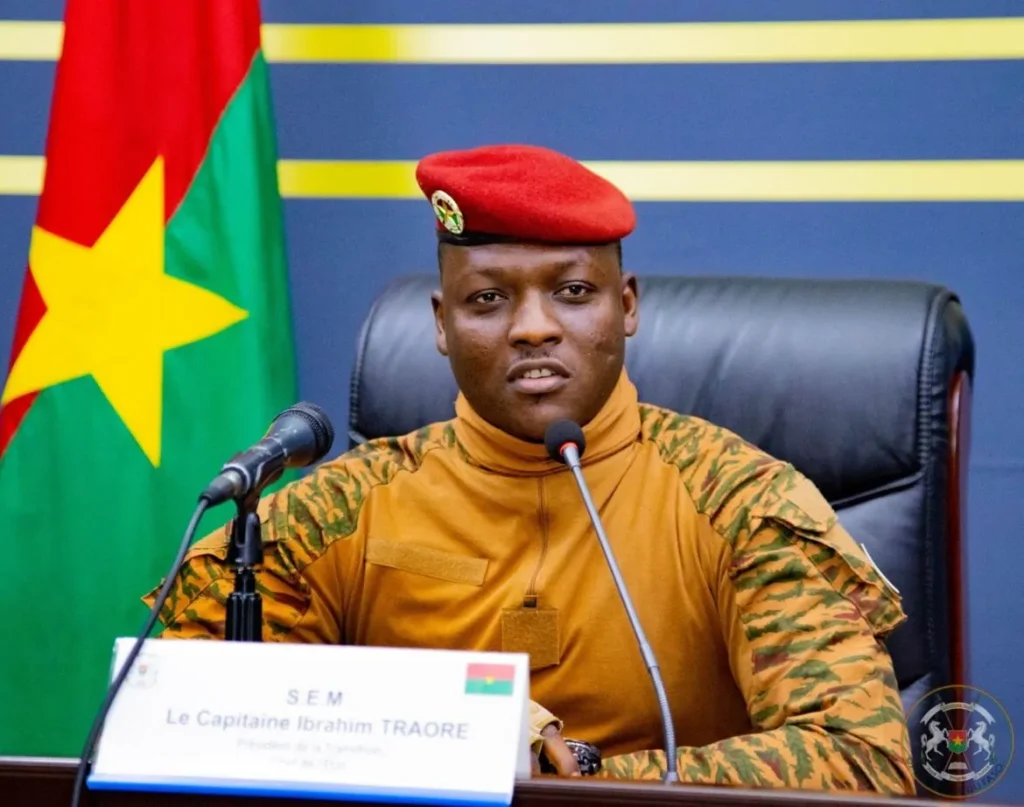
Ibrahim Traoré (born 14 March 1988) is a Burkinabé military officer who has served as the interim leader of Burkina Faso since the September 2022 coup that removed interim president Paul-Henri Sandaogo Damiba. At 36 years old, Traoré is the world’s second-youngest serving state leader, after Icelandic Prime Minister Kristrún Frostadóttir, and holds the distinction of being the youngest serving president.
Early Life
Born in Kéra, Bondokuy, Mouhoun Province, on 14 March 1988, Ibrahim Traoré began his education in Bondokuy before attending high school in Bobo-Dioulasso, where he earned a reputation as “quiet” and “very talented.” Starting in 2006, he pursued geology at the University of Ouagadougou. He was actively involved in the Association of Muslim Students and the Marxist student group Association nationale des étudiants du Burkina (ANEB), where he rose to a delegate position and was known for defending his peers in disputes. Traoré graduated with honors.
Military Career
Traoré joined the Burkinabé Army in 2009, completing training at the Georges-Namoano Military Academy. He underwent anti-aircraft training in Morocco before being assigned to an infantry unit in Kaya, a northern town in Burkina Faso. In 2014, he was promoted to lieutenant and joined the United Nations peacekeeping force MINUSMA, participating in the Mali War. In 2018, he was commended for his bravery during significant rebel attacks in the Tombouctou Region. Returning to Burkina Faso, Traoré took part in counter-insurgency operations against jihadist insurgents, including the 2019 “Otapuanu offensive” in Djibo and other missions in the north.
Promoted to captain in 2020, Traoré became disillusioned with the country’s leadership, citing the inadequate equipment for soldiers while politicians engaged in corruption. Over time, he emerged as a voice for northern-based soldiers frustrated with the government’s shortcomings.
Rise to Power
Ibrahim Traoré played a key role in the January 2022 Burkina Faso coup d’état, which brought the Patriotic Movement for Safeguard and Restoration (MPSR) military junta to power. By March 2022, he was commanding an artillery regiment in Kaya. His association with the “Cobra” special forces, a counterterrorism unit established in 2019, is disputed. While sources such as the BBC, Al Jazeera, and Die Tageszeitung claim he was part of the unit, the news outlet Jeune Afrique reported otherwise.
Discontent grew among supporters of the January coup, particularly over interim leader Paul-Henri Sandaogo Damiba’s failure to effectively tackle the jihadist insurgency. Traoré later stated that he and other officers had urged Damiba to prioritize the rebellion but eventually decided to depose him, accusing Damiba of losing focus on their mission. Dissatisfaction was especially pronounced among younger officers fighting on the frontlines, compounded by delays in pay for the “Cobra” troops.
On 30 September 2022, while still a captain, Traoré and his allies launched a coup, with support from the “Cobra” unit. Following the successful takeover, he was selected as the new leader of the MPSR. On 6 October, Traoré assumed the roles of Interim President, Head of State, and Supreme Head of the Armed Forces. He initially pledged to hold democratic elections by July 2024.
However, on 25 May 2024, the military junta announced a five-year extension of its rule, confirming that Traoré would remain in office during this period.
Presidency
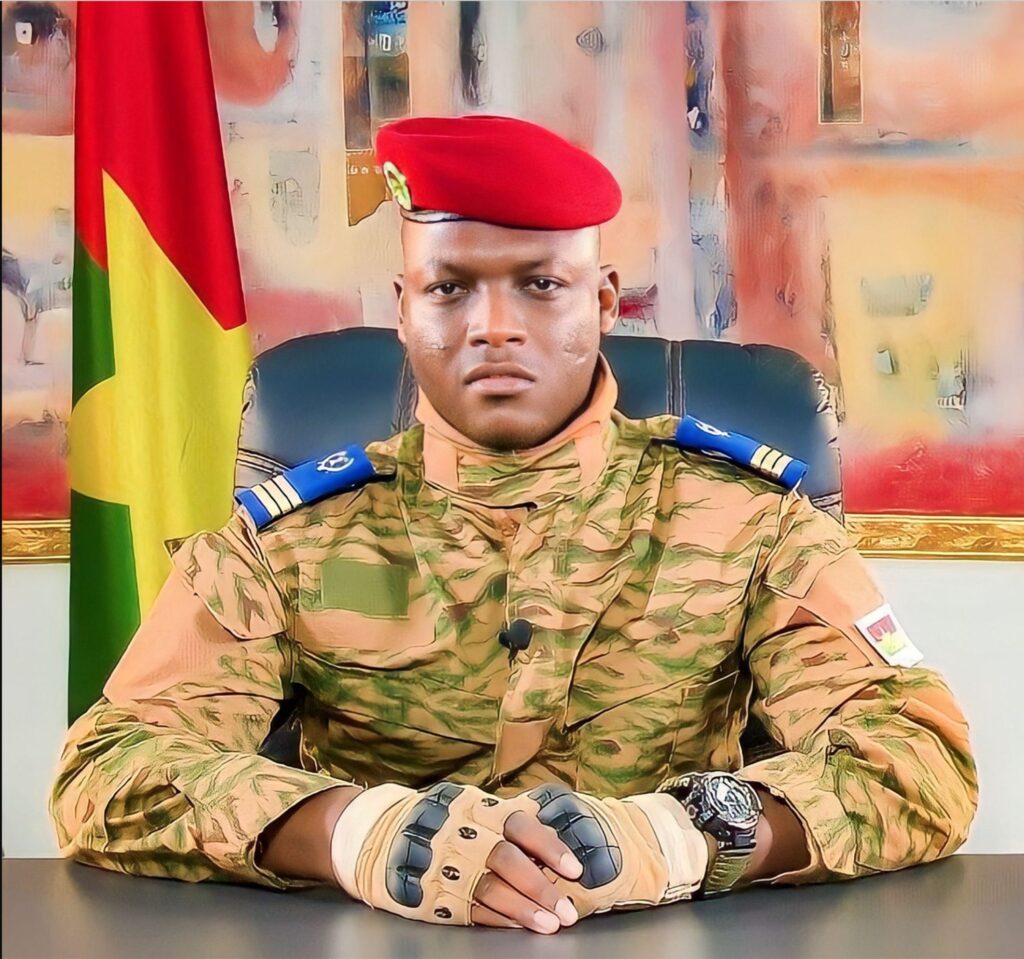
As president, Ibrahim Traoré has upheld a reserved and highly formal demeanor, a trait he was known for before assuming leadership. He has tightly managed his communication, aiming to project the image of a disciplined wartime leader, likely to avoid the negative public perception associated with his predecessors. His tenure has also been marked by a rise in pro-government propaganda across traditional media and social platforms in Burkina Faso. Politically, Traoré has been described by Le Monde journalist Sophie Douce as influenced by Marxism and pan-Africanism.
In February 2023, Traoré’s government expelled French forces assisting in the fight against local insurgencies. He justified this move by emphasizing the need for “win-win partnerships” and the diversification of Burkina Faso’s international alliances. Subsequently, his administration supported the idea of a federation with Mali and extended the invitation to Guinea, all of which are under military rule. If realized, this union would form the largest region governed by military juntas. To replace French support, Traoré fostered closer ties with Turkey and Russia.
In April 2023, Traoré announced a “general mobilization” of the population to support the military amidst escalating rebel attacks. He vowed to reclaim all territories under rebel control and rejected the possibility of negotiations until significant progress was made against the insurgency. By May, he expressed doubts about holding democratic elections in 2024, citing the need for improved security and a reduced insurgent threat.
On 26 September 2023, an attempted coup by dissatisfied military elements against Traoré failed. National consultations held on 25–26 May 2024 included diverse representatives such as religious leaders, political figures, union leaders, NGOs, and others. These discussions led to the extension of Traoré’s mandate by five years and allowed him to run in the next presidential elections.
In July 2024, the military junta proposed a bill to criminalize homosexuality, though parliamentary approval is pending. Later, on 6 December, Traoré dissolved his government and dismissed de Tambèla from the position of Prime Minister.
Gold and General Mining Sector Developments
In November 2023, Burkina Faso’s Council of Ministers approved the construction of its first gold refinery, signaling a major advancement in the nation’s gold sector. This initiative aims to refine gold domestically instead of exporting unprocessed materials, boosting government revenues and maximizing economic benefits from gold mining. The refinery is expected to produce approximately 400 kilograms of gold daily, creating 100 direct jobs and 5,000 indirect jobs.
By January 2024, Burkina Faso furthered its mining advancements with the launch of a “revolutionary” mine tailings treatment plant using domestically developed technology. This plant focuses on extracting valuable metals from mine tailings such as slag, fine coal, and ash, enhancing resource recovery and reducing environmental pollution. This innovation underscores the country’s commitment to sustainable and responsible mining practices, combining resource efficiency with reduced waste. The project highlights Burkina Faso’s reliance on local expertise, boosting profitability, promoting environmental sustainability, and advancing domestic technological capabilities in the mining sector.
In February 2024, President Ibrahim Traoré suspended the issuance of export permits for small-scale private gold producers to combat illicit trade and improve accountability in the artisanal gold sector. The suspension targets gold smuggling, which evades taxes and regulations, ensuring that all exported gold is documented and contributes to national revenue. The government aims to establish a more formalized system for small-scale gold exports through this measure.
Alleged Association with Russia
Ibrahim Traoré has faced allegations of connections with Russia’s Wagner Group due to his anti-French and pro-Russian rhetoric. Reports from Reuters and The New York Times noted that as Traoré entered Ouagadougou following the coup, supporters waved Russian flags. Ghana’s government accused him of collaborating with Wagner, enlisting their support against jihadist rebels. Traoré denied this, stating, “Our Wagner are the VDP,” referring to Burkina Faso’s Volunteers for the Defense of the Homeland.
In July 2023, after the Russia–Africa Summit, Traoré announced plans to reopen the Russian embassy in Burkina Faso, which had been closed since 1992, claiming strong public support for Russia. While Le Monde reported in May 2023 that Traoré’s administration was focusing on using local forces to combat jihadists rather than relying on Wagner, Russian troops, including members of the Wagner Group, were eventually deployed in Burkina Faso in January 2024.
The transatlantic slave trade, which lasted from the 15th to the 19th centuries, involved the capture, enslavement, and sale of millions of Africans, often with the participation of local African rulers and merchants. Some African tribes and kingdoms enslaved others, either through warfare or raids, and sold captives to European and Arab traders. Below are examples of African groups and rulers associated with such practices during the slave trade:
Tribes and Kingdoms That Enslaved Others:
- Ashanti Empire (Ghana):
- The Ashanti Empire, located in present-day Ghana, was a powerful and organized state that frequently conducted raids on neighboring communities to capture slaves. These slaves were often traded for firearms and other goods with European merchants.
- The Ashanti used the slave trade to bolster their wealth and power, with the trade forming a crucial part of their economy.
- Dahomey Kingdom (Benin):
- The Kingdom of Dahomey was one of the most active participants in the transatlantic slave trade. It conducted military campaigns against rival groups, capturing prisoners who were sold into slavery.
- Dahomey’s rulers, including King Gezo (1818–1858), openly defended the slave trade as a source of economic and political strength.
- Oyo Empire (Nigeria):
- The Oyo Empire, a powerful Yoruba state, engaged in extensive slave trading. It conducted raids on neighboring communities to supply European merchants with slaves in exchange for goods like guns and textiles.
- Kongo Kingdom (Angola/DR Congo):
- The Kingdom of Kongo, while initially resisting the slave trade under some rulers, became heavily involved in capturing and selling slaves. Internal conflicts and warfare often resulted in prisoners being sold to Portuguese traders.
- Imbangala (Angola):
- The Imbangala were a group of warrior societies in Angola known for their brutal raids and enslavement of other tribes. They sold captives to the Portuguese in exchange for goods.
Rulers Who Sold Their Own People:
- King Gezo of Dahomey:
- King Gezo defended the slave trade, asserting that it was integral to Dahomey’s economy. He justified selling captives from other tribes as well as internal criminals into slavery.
- King Afonso I of Kongo (Nzinga Mbemba):
- Initially opposed to the slave trade, Afonso I later participated in it under pressure from Portuguese traders. He condemned the illegal enslavement of his subjects but continued to trade slaves captured in wars.
- Oba of Benin (Various):
- The rulers of the Kingdom of Benin (in present-day Nigeria) engaged in the slave trade by selling war captives and criminals. They maintained trade relationships with Portuguese, Dutch, and British merchants.
- King Tegbesu of Dahomey:
- Tegbesu (1740–1774) expanded Dahomey’s involvement in the slave trade and used the revenue to strengthen his kingdom.
- Local Chiefs and Leaders:
- Throughout West and Central Africa, many smaller chiefs and rulers participated in the slave trade by selling captives, including individuals from their own communities, often as a means of consolidating power or obtaining European goods.
Motivations and Dynamics:
- Economic Incentives: African rulers and merchants often saw the slave trade as a means to acquire firearms, luxury goods, and economic wealth.
- Internal Conflicts: Many enslaved individuals were prisoners of war, captured during conflicts between rival groups.
- European Demand: The demand for labor in the Americas created strong incentives for African leaders to supply slaves.
Consequences:
The slave trade devastated many African societies, leading to depopulation, destruction of communities, and long-term economic and social disruptions. While some rulers and groups gained short-term wealth and power, the trade ultimately contributed to instability and colonial domination in the region.
Thank you for reading.