
By Africarized – Rewriting the African Narrative
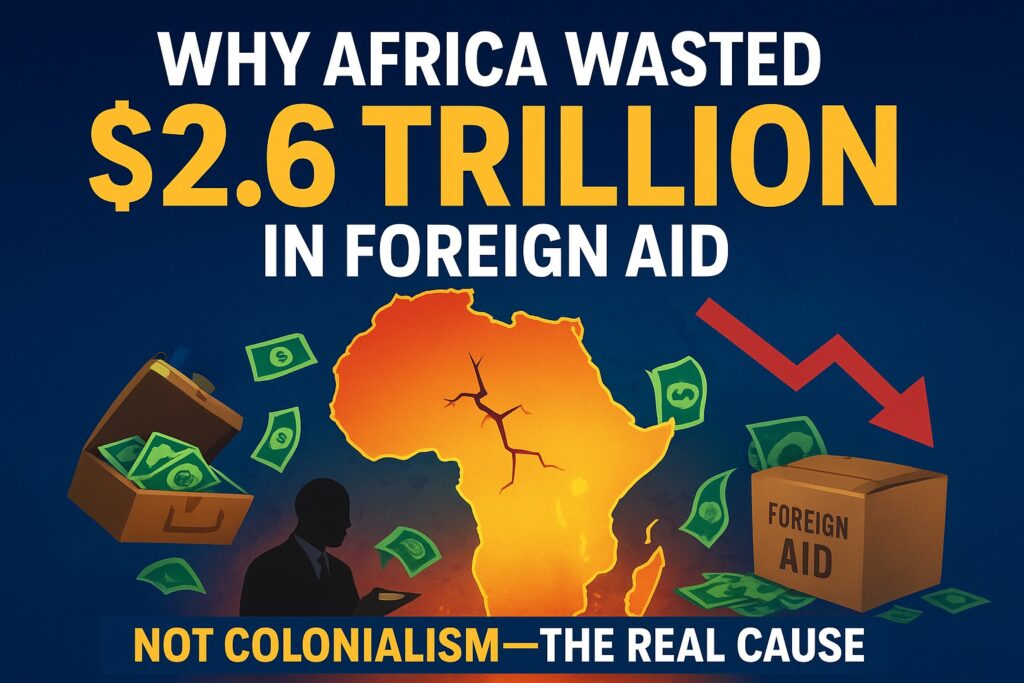
For more than 70 years, Africa has been the single largest recipient of foreign aid in human history. Over $2.6 trillion—from governments, NGOs, global institutions, and charities—has flowed into the continent.
Yet the results are nothing short of tragic:
- 350 million Africans still lack clean drinking water.
- 43% of the continent still has no electricity.
- The number of Africans living on less than $2 a day has grown from 280 million in 1990 to 430 million today.
Meanwhile, the rest of the world is moving out of poverty. Global extreme poverty fell from 1.9 billion people in 1990 to 736 million today. Everywhere else—Asia, South America, Eastern Europe—poverty declined sharply.
But in Africa, despite trillions in aid, poverty expanded.
So the real question is:
If colonialism is no longer here, and $2.6 trillion has been poured into Africa… why is Africa still poor?
The uncomfortable answer:
Foreign aid became fuel for the very systems that keep Africa underdeveloped.
Let’s break it down.
1. 75% of Aid Projects Failed — According to the World Bank
A ground-breaking World Bank review of African agricultural aid projects found:
“75% of foreign aid programs in Africa failed.”
Not “underperformed.”
Not “partially worked.”
Failed. Completely.
Examples include:
Operation Millets (Mali, 1970s)
Goal: Expand grain production.
Outcome: Government-imposed price controls collapsed production by 80%. Aid didn’t help farmers—it distorted the market and destroyed incentives.
Senegal Cattle Project
$4 million invested.
Goal: Grow livestock from 11,000 to 25,000.
Outcome: Only 900 cattle added.
These aren’t isolated incidents. They represent decades of misaligned, top-down, donor-engineered projects that misunderstood the local environment.
2. Aid Strengthens Weak Governments Instead of Strengthening Citizens
Here’s the brutal truth:
Foreign aid props up governments that would otherwise be forced by their own people to reform.
When aid money becomes the main revenue source instead of taxes, politicians stop being accountable to citizens.
No taxation = no pressure for reform, transparency, or service delivery.
The aid industry unintentionally:
- Keeps bad leaders in power
- Funds corruption networks
- Removes incentives for innovation
- Creates dependency within state structures
African governments learned they didn’t need to build strong economies—they only needed to maintain good relationships with donor countries.
3. Aid Crushed African Entrepreneurship
Imagine you are an African entrepreneur trying to start:
- a water company,
- a small farming equipment business,
- or a local school supply startup.
Then suddenly…
NGOs arrive and give away those exact products for free.
You can’t compete with “free.” So you close.
This is why African markets remain weak—foreign aid repeatedly destroys local industries before they even mature.
Economists call this the “NGO Market Kill Effect.”
It is one of the least discussed but most devastating consequences of foreign aid.
4. Countries With Little to No Foreign Aid Surpassed Africa
Now, here is the knockout punch…
Singapore vs. Senegal
Both were colonised.
Both gained independence in the 1960s.
Both are small countries.
Singapore received almost no foreign aid.
Senegal received billions.
Today:
- Singapore is richer than its former coloniser, Britain.
- Senegal remains one of the poorest countries in the world.
What did Singapore do differently?
- Protected economic freedom
- Welcomed investment
- Avoided socialist central planning
- Crushed corruption
- Made education and productivity national priorities
Meanwhile, across Africa during the same era…
20 African countries adopted Marxist-Leninist or socialist economic systems.
The results:
- State-controlled everything
- No room for private business
- No market innovation
- Corruption flourished
- Growth collapsed
This is not about ideology—it’s about outcomes.
5. Foreign Aid + Bad Policy = Permanent Poverty
Some African leaders embraced policies that simply do not create wealth:
- price controls
- state monopolies
- excessive regulations
- anti-private sector policies
- political patronage
Foreign aid masked the economic damage created by these policies. It acted as a crutch that allowed governments to avoid reform.
And because aid comes with political strings attached, it also ensured the West kept influence over African economic trajectories long after independence.
6. The Truth: Africa Isn’t Poor Because of Lack of Resources or Aid
Africa is the richest continent on Earth in natural resources.
Africa is the most aid-funded continent in history.
So the problem is not:
❌ Lack of minerals
❌ Not enough aid
❌ Not enough coloniser reparations
The real problem is:
Bad governance + wrong policies + dependency on foreign systems.
If the problem were colonialism alone, countries like:
- Singapore
- India
- Malaysia
- Vietnam
- Rwanda
- South Korea
…would not have become economic powerhouses after colonial rule ended.
But they did.
Because they built the right systems.
7. So Why Did Africa Misuse $2.6 Trillion in Aid?
Here is the summary:
1. Aid rewarded corruption, not performance
Leaders gained more by maintaining poverty than fixing it.
2. Aid weakened local businesses
Free foreign goods undercut local producers.
3. Aid empowered governments, not citizens
Money flowed through state institutions—breeding dependency.
4. Aid encouraged bad economic policies
Countries that pursued socialist-centralised models stagnated.
5. Aid disconnected African leaders from their people
Governments didn’t need taxpayers—donor money was enough.
8. Africa Can Still Rise — But Not Through Aid
The African future will be built by:
- Strong institutions
- Private sector empowerment
- Economic freedom
- Free markets that encourage innovation
- Regional trade (AfCFTA)
- Supporting African entrepreneurs
- Ending state capture
- Ending dependency on donors
Other nations proved it can be done.
Rwanda transformed itself without massive aid programs.
Botswana built one of Africa’s strongest economies through good policy.
Ethiopia industrialised by focusing on investment and manufacturing.
When Africans create wealth for themselves—without dependency—that is when true liberation begins.
Closing Message from Africarized
Africa does not need pity.
Africa needs systems that work.
It is time to stop repeating the myth:
“Foreign aid will develop Africa.”
It never has.
It never will.
Economic freedom, good governance, and African innovation will.
If you want to explore more powerful truths about Africa’s economic history and future, visit the Africarized Shop for books, apparel, and merchandise designed to inspire a new generation of African thinkers and builders.
Subscribe to Africarized YouTube channel for latest informative videos
👉 Visit: Africarized Shop
Wear the movement. Support the mission. Shape the future.